The Wildebeest Slam
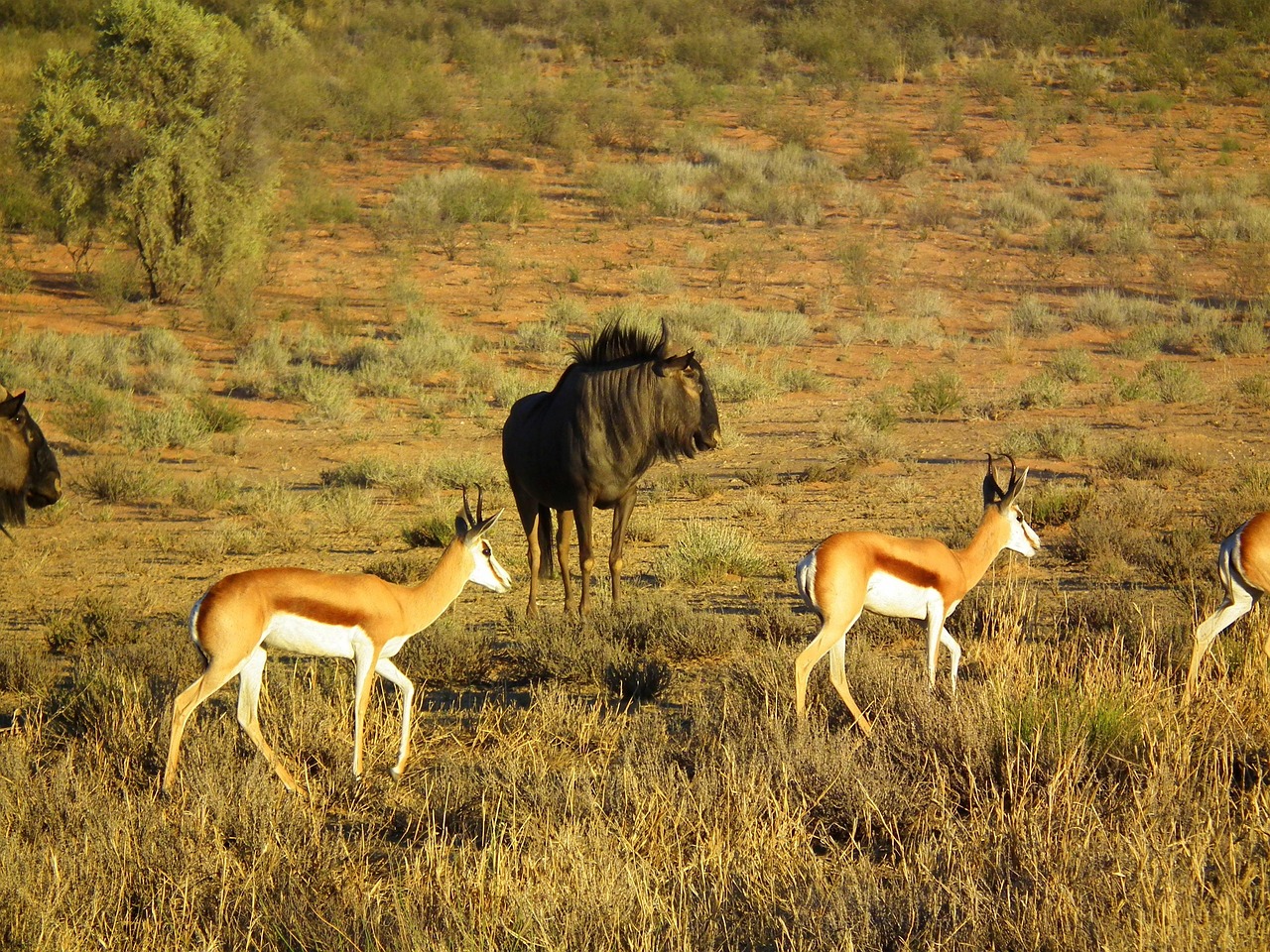
Hunters call the blue wildebeest the poor man's buffalo, and they mean it as a compliment: pound for pound the wildebeest clan absorbs more lead and shrugs off more mistakes than anything else on the plains. The slam collects the whole clan — two species, the two great East African races, and for those who want them, the bred golden and king variants — and it is one of the most achievable multi-country collections in Africa.
In this guide
The wildebeest checklist
| # | Animal | Where | The short version |
|---|---|---|---|
| 1 | Blue wildebeest | South Africa, Namibia, Zimbabwe, Botswana, Tanzania | The brindled original — the toughest ordinary animal in Africa. |
| 2 | Black wildebeest | South African highveld and Karoo; Namibian farms | The white-tailed endemic that came back from the brink — a pure South African story. |
| 3 | Nyasa wildebeest | Niassa, northern Mozambique; southern Tanzania | The remote leg — a wild daily-rate safari in genuine wilderness. |
| 4 | Eastern white-bearded wildebeest | Tanzania — Masailand | The classic East African, hunted on licence in big open country. |
| 5 | Golden wildebeest (optional) | South African ranch country | The bred colour variant that started the boom — see the colour-variant guide. |
| 6 | King wildebeest (optional) | South African ranch country | The darker crowned variant — the collector's optional sixth. |
The toughest ordinary animal in Africa
Every professional hunter has a wildebeest story and they all end the same way: the animal soaked up a shot that would have flattened a kudu and ran a kilometre. The frame is dense, the shoulder is armoured in muscle, and the vitals sit lower and further forward than the slab-sided body suggests. Aim on the point of the shoulder, use a stout bullet in the .270-to-.300 class or heavier, and be ready to shoot again without admiring the first one. The nickname "poor man's buffalo" is earned twice over — once for the toughness, once for the attitude of an old bull facing you head-on.
Blue and black — the home pair
The blue wildebeest is everywhere from the Kalahari to the Lowveld and belongs on any first safari. The black wildebeest is the special one: a South African endemic that had been shot down to a few hundred animals by the early twentieth century and was saved entirely by farmers who fenced and bred the survivors — one of conservation-through-ownership's founding stories. Today tens of thousands live on the highveld and Karoo plains where they belong, circling and snorting with that strange looping gallop, white tails flagging. Taking both in open country is a proper introduction to plains shooting: black wildebeest especially live in flat, shadowless grassland where 250-metre shots in wind are the norm.
The northern legs
The slam's character changes completely north of the Limpopo. The Nyasa wildebeest — with the white nose-band — is hunted in the Niassa wilderness of northern Mozambique and southern Tanzania, on classic daily-rate safaris in country measured in thousands of empty square kilometres. The eastern white-bearded wildebeest of Tanzania's Masailand is the beast of the great migrations, taken on licence in the open savannah where East African hunting was invented. Neither is expensive as a trophy; both demand the journey — which is exactly why the finished slam means something.
The bred additions
South African ranchers bred the naturally occurring dark and pale genes of the blue wildebeest into two striking stable variants: the golden wildebeest, all bronze and flame, and the king wildebeest with its dark crowned cape. Purists finish the slam at the four wild forms; collectors add the two variants for a six-strong wall that visitors cannot walk past. Prices on the variants have fallen to sensible hunting money since the breeding boom broke — the full story is in the colour-variant guide.
Cost and the honest plan
Blue and black wildebeest run roughly $900 to $1,500 each — two of the best-value hard hunts in Africa — and golden or king variants typically $2,000 to $3,500 in today's market. The Nyasa and white-bearded legs are inexpensive as trophy fees but ride on wilderness daily-rate safaris, so most hunters take them as part of a bigger Mozambique or Tanzania hunt rather than as a dedicated trip. The efficient slam: home pair on any South African safari, northern pair attached to the buffalo or spiral-horn expedition you were planning anyway.
A slam that starts on a Free State plain and ends in Niassa is a travel story as much as a hunting one. Post each leg on the Telegraph and let your Trophy Room hold the finished clan.
Join free → Post it on the Telegraph →
Part of The Bush Telegraph — verified records live in your Trophy Room and on the leaderboards. Off-platform, we're @safarihunts on X.